
A Data Integration Technology Selection Framework
Data integration appears simple, but selecting the right technology is a critical—and often complex—decision

The purpose of this document is to provide clear guidance to IT teams on selecting the appropriate integration platform based on specific use cases. While this serves as a directional framework, it is important to recognize that multiple technologies may be suitable depending on the nature and complexity of the integration.
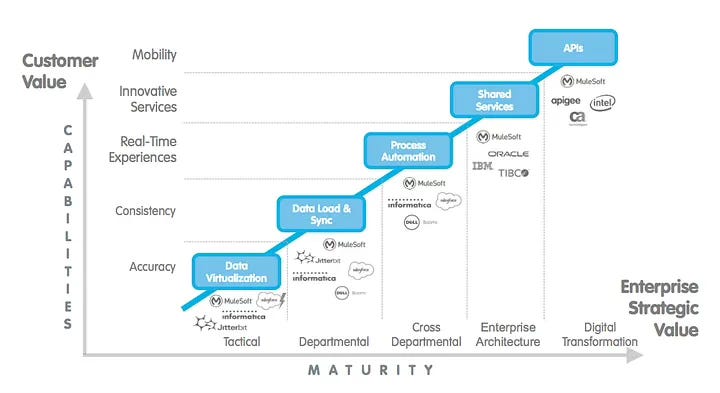
As you evaluate data and integration requirements, it is critical to consider both strategic and tactical dimensions—the value delivered is directly correlated to this perspective. The Data Integration Maturity Matrix referenced below illustrates how various integration activities contribute to the organization’s overall maturity. Complementing this, the Technology Decision Matrix is intended to guide teams toward IT-supported technologies aligned to their needs. The following sections outline each integration activity, including business and technical drivers, key considerations, and representative use cases, along with recommended technologies.
Data Virtualization
Data virtualization enables applications to access and manipulate data without requiring knowledge of its physical location, format, or underlying structure. From a CIO perspective, this approach can accelerate access to distributed data while minimizing data movement.
Business Drivers
Integrated view of information through a unified interface
Improved user productivity and reduction in manual errors
Technical Drivers
UI-level integration across disparate systems
Consistency without the need for replication or synchronization
Unified data access via technologies such as the SFDC OData XDS Connector
Considerations
Requires data sources to be exposed as OData API feeds
Limited to presentation-layer integration; does not support transformation or orchestration for higher-value use cases
Typically point-to-point and tightly coupled to source systems
Salesforce Connect (as of FY15Q4) supports read-only access to external data sources
Use Case Examples
Mobile and web applications accessing distributed data sources
Cloud-based application logic leveraging externalized data
Salesforce accessing legacy systems without data movement
BI tools querying multiple heterogeneous data sources
Recommended IT Technology
MuleSoft
Jitterbit
Data Load
Data load refers to the bulk movement and transformation of data between systems, commonly associated with data warehousing and migration scenarios.
Business Drivers
One-time system cutovers and migrations
Loading cleansed customer, lead, or operational data
Technical Drivers
High-volume bulk data movement
Support for complex data transformations
Targeted solutions for specific, well-defined use cases
Considerations
May require multiple iterations to achieve desired outcomes
Latency and processing windows must align with business requirements
Performance optimization often requires specialized data loading logic
Typically results in tightly coupled architectures with higher long-term maintenance costs
Use Case Examples
Bulk loading into data warehouses
Database-to-database migration
Replicating large datasets across environments
Supporting backup, disaster recovery, or failover strategies
Loading data into cloud-based platforms
Recommended IT Technology
MuleSoft
Informatica
Jitterbit
Salesforce Import Wizard
Data Synchronization
Data synchronization ensures consistency across systems by continuously aligning data between source and target environments over time.
Business Drivers
Creation of a unified customer view
Consistent cross-channel customer experiences
Improved decision-making and operational performance
Technical Drivers
Bi-directional or multi-system data consistency
Real-time or scheduled synchronization capabilities
Maintenance of data integrity across platforms
Considerations
Latency requirements (real-time vs. batch) must align with business needs
Increasing data volumes can impact scalability and performance
Data reconciliation complexity varies by implementation
Data profiling is recommended before synchronization
Conflict resolution strategies must be defined (e.g., system of record, ownership rules)
Use Case Examples
Ongoing data warehousing for analytics
Synchronization across CRM, ERP, and other enterprise platforms
Recommended IT Technology
MuleSoft
Informatica
Jitterbit
Process Automation
Process automation integrates systems and orchestrates workflows to streamline operations, reduce costs, and improve consistency across the enterprise.
Business Drivers
Automation of cross-functional business processes
Enhanced customer experiences through real-time responsiveness
Reduction in operational costs
Improved compliance and risk management
Technical Drivers
Fragmented data and workflows across departments
Orchestration of processes across multiple application silos
Alignment with internal service-level agreements (SLAs)
Considerations
Availability of APIs for systems and data access
Data ownership, location, and accessibility
Real-time processing requirements
Use Case Examples
New hire onboarding automation
Quote-to-cash process orchestration
Automated incident and outage management
Recommended IT Technology
MuleSoft
Informatica
Shared Services
Shared services represent a service-oriented approach where reusable components and capabilities are made available across the enterprise to drive consistency and efficiency.
Business Drivers
Accelerated time-to-market for products and initiatives
Increased ability to innovate and respond to market opportunities
Reduced operational costs through reuse and standardization
Technical Drivers
Application decoupling and code reuse
Simplified maintenance of large-scale integration environments
Standardized data definitions and formats
Considerations
Requires strong executive sponsorship to drive adoption of a service-oriented architecture (SOA)
Necessitates a centralized service layer acting as an internal provider
Requires upfront investment to achieve long-term returns
Use Case Examples
Reliable delivery of business-critical data events (e.g., customer orders)
Reduced dependency between source and consuming systems
Reuse of services across new and existing applications
Recommended IT Technology
MuleSoft
APIs
APIs define standardized interfaces that enable systems to communicate while decoupling implementation from consumption. From a strategic standpoint, APIs are foundational to digital business models and ecosystem integration.
Business Drivers
Enabling mobility and connected digital experiences
Monetizing data and creating new revenue streams
Driving operational efficiency across the enterprise
Technical Drivers
Standardized and secure access to enterprise and application data
Ability to monitor, govern, and audit usage
Decoupling of consumers from backend systems
Increased visibility into data definitions and quality
Considerations
Broader API adoption increases ROI and lowers the marginal cost of integration
Requires skilled resources for design, implementation, and lifecycle management
Must be designed with a clear audience and use case in mind
Requires lifecycle governance beyond initial deployment
Use Case Examples
Real-time data access for mobile and web applications
Process automation through the orchestration of multiple APIs
Recommended IT Technology
MuleSoft
Technology Decision Matrix
Selecting the appropriate integration technology can be complex, particularly in a rapidly evolving technology landscape. The Technology Decision Matrix is designed to simplify this process by aligning use cases with recommended platforms. However, it should be used in conjunction with guidance from the Enterprise Architecture Review Board (EARB), as specific business and technical requirements will ultimately determine the best fit.
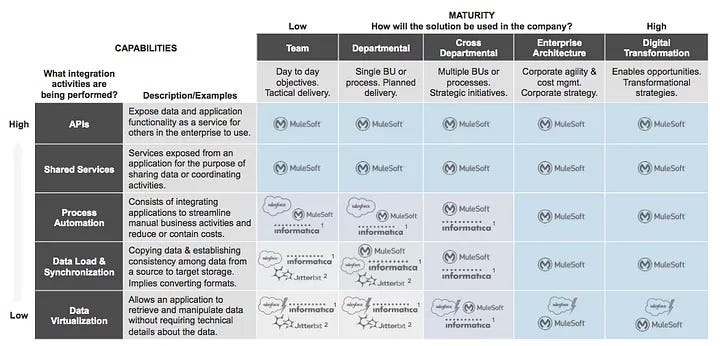
This framework is intentionally adaptable and should evolve alongside the organization’s capabilities and technology portfolio. As CIOs, our role is to ensure that such frameworks not only guide decision-making but also promote consistency, scalability, and long-term architectural integrity across the enterprise.