
Redefining The Enterprise Integration Platform
With the advent of SaaS, cloud computing, and design thinking it's time to rethink how companies integrate critical applications

Over the past 14 years, Salesforce has experienced remarkable growth. In just 12 years, the company reached $2 billion in annual revenue, compared with 16 years for Microsoft, 17 years for Oracle, and 23 years for SAP to reach the same milestone. As with any high-growth organization, this level of pace creates a strong short-term focus, particularly when it comes to internal integrations. Teams move quickly to meet business requirements and keep the company advancing. Over time, however, this can lead to an overreliance on point-to-point integrations rather than a more loosely coupled architecture. The result is often a complex environment that becomes increasingly difficult and expensive to maintain.
That reality led my team and me to invest significant time in developing a long-term integration strategy aligned to the company’s vision of reaching $10 billion in annual revenue. Supporting an organization of that scale requires an architecture that can evolve with the business. As we designed our strategy, we established a set of guiding principles to support decision-making:
Cloud First. As a company that helped pioneer the Software-as-a-Service model, it was important that our integration strategy reflect the same cloud-first mindset that defines our broader business. That is easier said than done. Integration platforms are often slower to innovate than other areas of the technology stack, and they do not always adopt emerging trends quickly. We knew this principle would require discipline and careful evaluation.
Industry-Leading Technologies. The technology landscape continues to evolve rapidly, and end users increasingly expect enterprise tools to reflect the same modern experience they see in their personal lives. When enterprise IT organizations move too slowly, it can create frustration and reduce confidence in the platform. We wanted an architecture that would allow us to adopt new technologies as business needs changed, or work with a vendor committed to staying aligned with industry direction.
Focused on Success. Integrations require technologies that can transform, enrich, and move data reliably to its intended destination. Designing a reusable and consistent platform that can handle high data volumes, ensure delivery, and support analytics introduces significant complexity. We wanted a partner that was genuinely invested in our success and capable of helping us solve difficult architectural and operational challenges along the way.
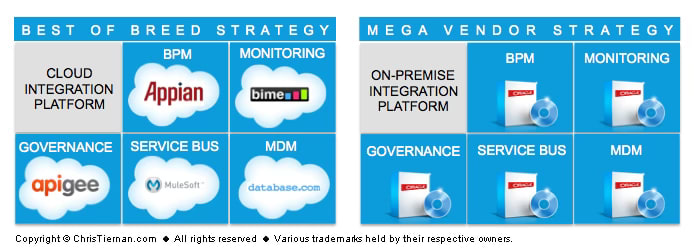
This led us to evaluate two broad approaches for an enterprise integration platform: a best-of-breed cloud strategy or a more traditional single-vendor on-premise strategy. The chart below illustrates how vendors may map to the major components of each approach.
Strategic Tradeoffs
At a high level, each model has distinct strengths and considerations.
Best-of-Breed Cloud Approach
Strengths
Risk is distributed across multiple vendors.
Best-in-class products can be selected for each function.
Lower total cost of ownership and a smaller hardware footprint.
Considerations
Multiple cloud vendors may be required to complete the platform.
Custom development may be necessary to close security or functional gaps.
May be more suitable for smaller companies or acquisition targets.
Single Provider Approach
Strengths
Mature company and product offering.
Can support future growth and maturity.
Simplified accountability with a single vendor relationship.
Considerations
Greater vendor lock-in.
Higher total cost of ownership due to hardware and support.
May not fully align with a cloud-first vision over time.
In the end, our experience reinforced the value of working with multiple vendors that excel in their respective domains. A best-of-breed cloud strategy can provide the depth and flexibility needed to support future change. Just as importantly, it can energize integration teams by giving them access to leading technology rather than forcing compromise around a single stack.