
The Self-Service Data Delivery Platform for Next Generation Companies
Companies must strategically invest in application integration—or risk falling behind.

Not long ago, I had the opportunity to present at the MuleSoft TopMule Meetup ’14 in San Diego, CA, on an initiative underway at Salesforce.com titled Free the Data: Transforming the Way the Business Connects to Data. With approximately 400 MuleSoft employees in attendance—and with the company having doubled in size within a year—the momentum reflects not only market demand, but a broader industry shift toward API-led connectivity and integration as strategic enablers. My presentation focused on how we are aggregating, exposing, and simplifying access to internal enterprise data—an area I believe sits at the heart of modern digital transformation.
As organizations accelerate their adoption of cloud technologies, the ability to seamlessly integrate and expose data across both cloud and on-premise environments is no longer a technical aspiration—it is an operational imperative. Enterprises that lead in defining, integrating, and democratizing access to their data will differentiate themselves in increasingly competitive markets. This advantage manifests in two critical dimensions: 1/ enabling real-time, structured data access to power business processes, applications, and automation; and 2/ unlocking the full value of data through advanced analytics, reporting, and predictive intelligence that informs decision-making at scale.
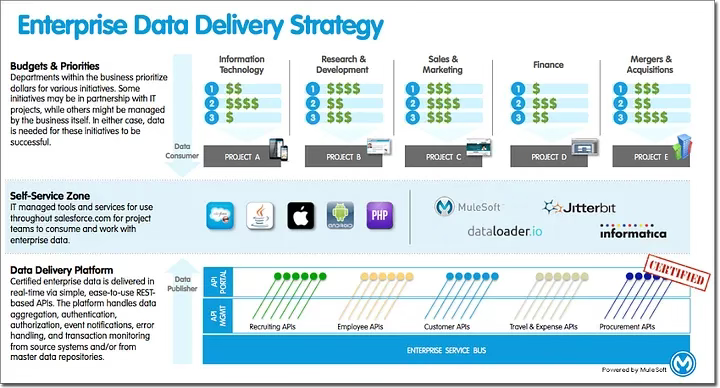
One slide from the presentation stood out as a blueprint for a long-term enterprise data strategy. At its core is a concept that I believe CIOs must champion: Data-as-a-Service (DaaS). To truly empower the business, accelerate growth, and foster a culture of innovation, enterprise data must be elevated to a managed, strategic service. This requires IT leadership to drive a data-centric operating model—one that encompasses governance, standardization, quality, enrichment, aggregation, and transport. While all of these components must function cohesively, the data transport strategy is often the catalyst that unlocks progress. Establishing scalable, reliable data transport layers requires intentional investment, specialized expertise, and early prioritization.
Budget & Priorities
Within any enterprise, resource allocation reflects strategic priorities. Marketing invests in customer engagement platforms, finance modernizes reporting for greater transparency, and IT drives automation to improve efficiency and reduce cost. While these initiatives may appear distinct, they share a common dependency: timely, accurate, and accessible data.
Increasingly, business units are making independent technology decisions—driven by greater technical fluency and the accessibility of cloud solutions. This trend underscores a critical leadership challenge: ensuring that decentralization of technology does not result in fragmentation of data. Regardless of where applications are deployed or who owns them, enterprise data remains the connective tissue. Without a coherent data strategy, organizations risk undermining the very agility they seek to achieve.
Data Delivery Platform
The Data Delivery Platform emerges as a foundational capability for modern enterprises. At its core, it is a curated set of web services—preferably RESTful APIs—that provide standardized, governed access to enterprise data. These services may expose aggregated views of employee, customer, and financial data, as well as enable access to streaming analytics, internal product systems, and external partner ecosystems.
From a CIO perspective, this platform is not simply an integration layer—it is a strategic asset. It establishes a scalable, reusable foundation that reduces duplication, accelerates development cycles, and enables consistent data access across the organization. As stewards of this capability, IT organizations must ensure its availability, performance, and security, while continuously evolving it to meet changing business demands.
Equally important is the concept of data certification. A platform is only as valuable as the trust placed in the data it delivers. Inaccurate or incomplete data erodes confidence and limits adoption. CIOs must therefore lead cross-functional efforts to institutionalize data governance, ensuring that data is accurate, consistent, and fit for purpose. Certified data is what transforms a technical platform into a trusted enterprise service.
Self-Service Zone
The role of IT is undergoing a fundamental shift—from a centralized service provider to an enabler of business-led innovation. As business users seek greater autonomy, IT must respond by delivering self-service capabilities that balance empowerment with governance.
This requires rethinking the enterprise technology stack to include Platform-as-a-Service (PaaS) capabilities that support a wide spectrum of users—from developers leveraging APIs and programming frameworks to analysts utilizing ETL and data integration tools. By standardizing access through a common platform, organizations can provide flexibility without sacrificing control.
Importantly, this model does not diminish the role of IT—it elevates it. IT becomes the architect of platforms, the curator of data, and the guardian of standards. Whether business units choose to partner with internal teams or external consultants, a unified platform strategy ensures consistency, accelerates delivery, and fosters a culture of innovation across the enterprise.
Final Thoughts
While business agility is often the most visible outcome of a Data Delivery Platform, the broader implications are transformational. By decoupling data from applications, organizations can significantly reduce the cost and complexity of development and maintenance. This architectural approach also enhances resilience, allowing underlying systems to evolve without disrupting downstream applications—provided that service contracts remain stable.
We are operating in an environment where the pace of change continues to accelerate, and expectations from customers, partners, and employees are higher than ever. In this context, access to data is not just a technical capability—it is a strategic differentiator.
CIOs and technology leaders must take an active role in shaping this future by investing in platforms and practices that make data accessible, trusted, and actionable. Organizations that succeed will not only gain a competitive advantage—they will define what it means to be a next-generation, data-driven enterprise.